Your lead plan writes itself.
Season 2, Episode 6 of "Superpowers" – documenting how we're replacing the media agency for smaller businesses, so they can capture leads they'd otherwise never get. Follow Season 2 here: smoc.ai/blog/categories/superpowers. Season 1 of 5 Minutes is here: smoc.ai/blog/categories/5-minutes-series.
We just shipped Lead Strategy. Here is how to use it.
Most teams set a lead goal, then wonder how to reach it. Add another LinkedIn seat? Boost the Meta budget? Launch a new campaign? The answer used to be guess, wait, measure, repeat. Lead Strategy answers for you.
Set the goal, get the plan
Open the dashboard and say how many leads you want this month. SMOC looks at your current performance — LinkedIn outreach, paid ads, organic traffic — and shows a path to close the gap.
The interface shows exactly what that path costs. A cost curve tells you where leads stay cheap and where they get expensive. A recommendation card breaks the plan into tactics you can check, uncheck, or adjust.
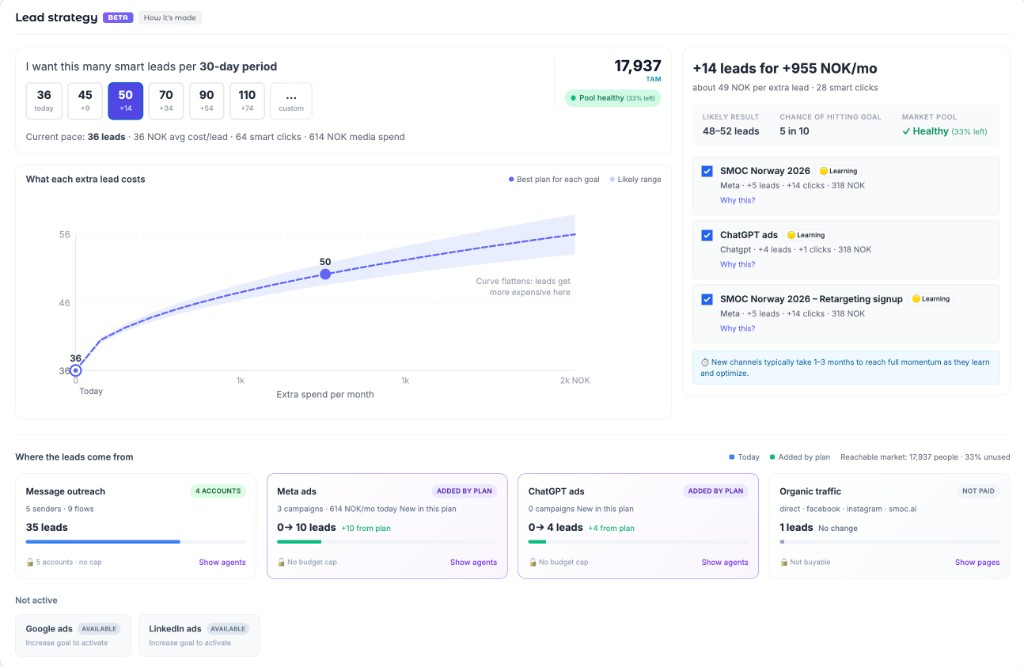
Picture a team on 36 leads that sets a target of 50 this month. Lead Strategy might say: add 14 leads for 955 NOK per month, expect 48–52 leads, 5-in-10 chance of hitting the goal. The math is on screen. Accept the plan, and the agents follow it.
Built on what already works
When your channels have history, Lead Strategy learns from them. Your reply rate, your cost per lead, your conversion patterns. It uses that data to project what happens when you turn a dial.
When you are just starting, or launching a new channel, Lead Strategy falls back to SMOC's aggregated benchmarks and industry averages. The estimate is less personal, but still realistic.
Either way, the system runs thousands of simulations — different mixes of LinkedIn accounts, ad budgets, and organic bets — then ranks them by efficiency. The top plans surface first.
Constraints the model respects
A media agency might suggest spending more on Google Ads without asking if you have the budget. Lead Strategy knows your limits:
- LinkedIn accounts: How many seats you have, and what each one costs.
- Market pool: Your total addressable market (TAM). If the goal exceeds the pool, the plan says so.
- Budget caps: The monthly spend you set for each channel.
- Learning curves: A brand-new channel needs time to find its footing. The plan accounts for ramp-up.
You can also disable any tactic. Uncheck the Meta campaign you do not want. Uncheck the extra LinkedIn seat you are not ready to connect. The plan recalculates on the spot.
The screen at a glance
Goal selector: Drag to the lead count you want. Current pace shows what you are on track for today.
Cost curve: A chart of diminishing returns. The curve flattens as leads get pricier. A dot marks the best plan for your goal.
TAM and pool health: Your addressable market size, and how much of the pool remains untapped.
Plan card: The headline shows total extra leads and total monthly cost. Below it, likely result, chance of hitting goal, and market-pool status. Then a checklist of tactics: channel, lead contribution, cost, and a "Why this?" link for each.
Ramp-up note: New channels take 1–3 months to reach full momentum. The plan reminds you.
Why this matters
Before Lead Strategy, growth planning was spreadsheet work — or an agency call. Now the spreadsheet writes itself. You set a goal, the system shows a path, you accept or adjust.
That loop is what a media agency sells. We just gave it to every SMOC dashboard.
Try it today: open the Dashboard, set your goal, and see your plan.
Follow Season 2 here: smoc.ai/blog/categories/superpowers. Season 1 of 5 Minutes is here: smoc.ai/blog/categories/5-minutes-series.
Shipped this month — October 2026 release log.